
Case study / Hanover Communications
A PR agency's website that its own team runs
This is the story of how we moved Hanover Communications off WordPress and onto a site built around the work they actually publish, then stayed on to look after it.
- Client
- Hanover Communications
- Sector
- PR and communications
- Duration
- 13 weeks to launch, ongoing since
- What we did
- Build, content migration, ongoing support
Hanover Communications is a global PR and reputation consultancy, with offices in London, Brussels, Dublin and the Middle East. Reputation is what they sell, so their own website gets looked at harder than most. Clients check it before a pitch. Candidates check it before they apply. And people search for the team by name.
By 2022 the site was on WordPress, and everything on it was, underneath, the same thing: a post. A client case study, a podcast episode, a job advert and a policy briefing from Brussels were all one kind of content with different category tags. The marketing team could publish, but they were always fighting the structure to do it.
The challenge
Hanover publishes far more than a blog. Insight articles from every office. Client case studies. Profiles for well over a hundred consultants. Job vacancies, internships and apprenticeships. A podcast. Later, Rewire, their own magazine.
Each of those needs different fields, and they all need to be filterable by the same things: which sector, which office, which service. A case study tagged "Energy" and a vacancy in the energy team should mean the same "Energy". On WordPress that held together through tags and plugins, and it broke whenever someone forgot which tag to use.
The real brief was simple to say and fiddly to do: give a small marketing team a site where every kind of content has a proper home, and where they never need to ask us to publish something.
What we did
We started the build on 9 December 2022, and the new site went live on the evening of 8 March 2023, after one last DNS change with Hanover's IT team.
A home for every kind of content
We rebuilt the site on Statamic, a CMS that keeps content as files rather than in a database. The bulk of the work was the content model. There are separate content types for insights, case studies, team profiles, job vacancies, podcast episodes, magazine articles and pages, each with only the fields it needs. Across all of them run shared lists of sectors, offices, services and role types. That's why an insight piece can show related case studies from the same sector, and why the careers page can filter by office.
Moving years of content without losing the meaning
Migrating content between systems is rarely interesting, but it's where a lot of these projects go wrong. Hanover's archive had habits baked in. Some posts were credited to an "author" called Dublin, because that was the only way to say which office a piece came from.
We set up the structure and the importer. Hanover's web agency moved the posts across against a spec we agreed. We'd made one firm rule: authors are real people, linked to their team profiles, and offices are tags. It made the migration a little slower. It also means that years later every article still links to the person who wrote it.
Built to be looked after, not rebuilt
Every save in the CMS is committed to version control automatically. That gives a full history of who changed what and when, and nothing a content editor does can be lost. It has also kept the site easy to look after. Since launch we've added things as Hanover needed them, with no rebuild:
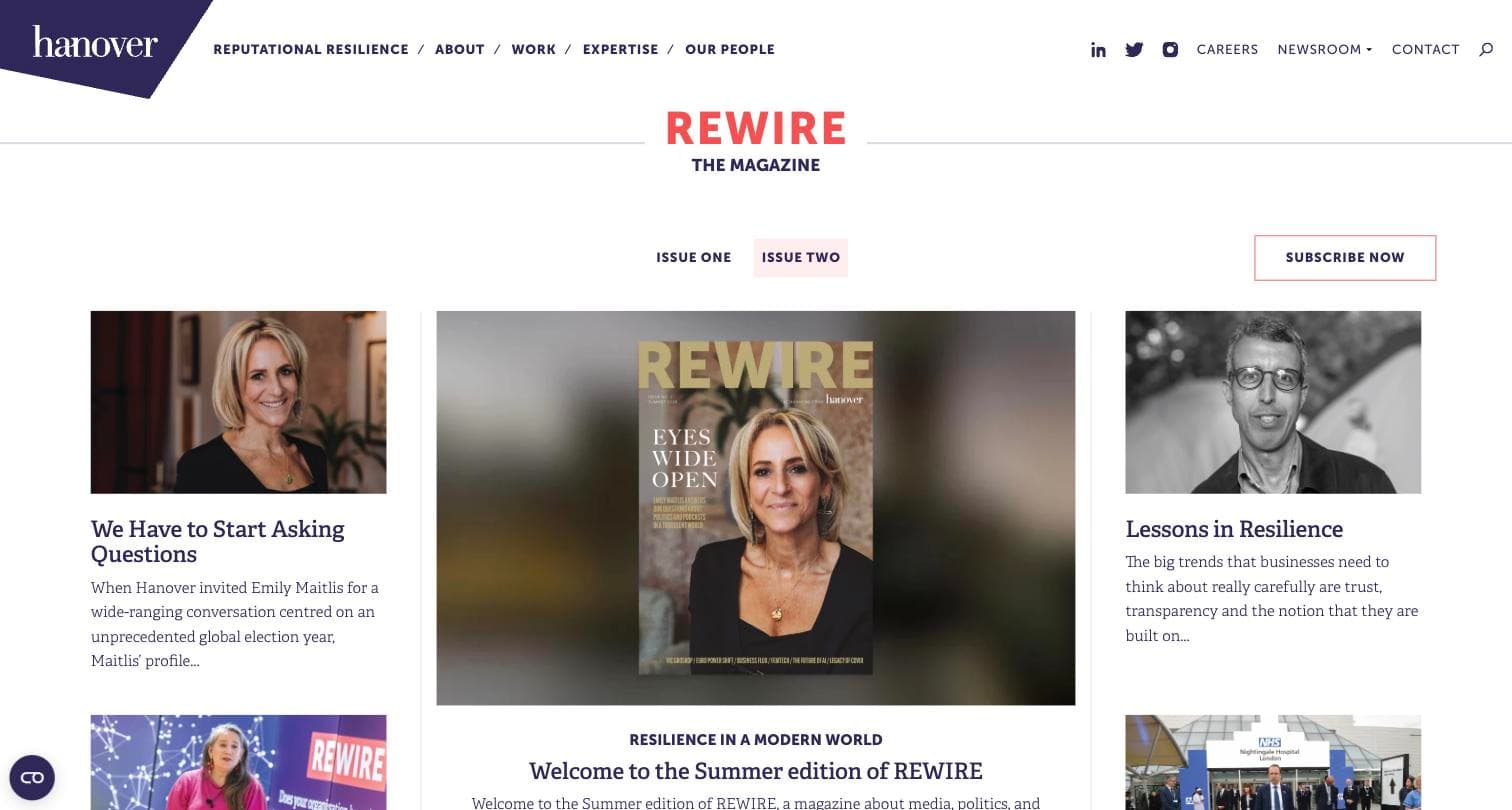
- Rewire, Hanover's magazine, with its own issues, articles and cover pages. Issue one went up in November 2023 and the summer edition in July 2024.
- A live careers section. In January 2024 we connected the vacancies page to Greenhouse, Hanover's recruitment system, so new roles appear on the site the moment HR posts them. Nobody copies job adverts across by hand any more.
- A podcast archive, and in 2026 a campaign page for the Brussels office and a Briefings section for their regular trade round-up.
Reporting that a marketing lead actually reads
The original build came before AI coding tools. AI is part of the support work now, though. From October 2026 Hanover's website team gets a weekly summary from us in plain English: visits, Google searches, which pages moved, what the team published and what we fixed. An AI workflow pulls it together from the analytics, Search Console and the site's own edit history, and Phil reads and approves every one before it goes. It turns a set of dashboards nobody has time to open into a few bullet points and one suggestion.
The results
Live in 13 weeks, from the first commit on 9 December 2022 to launch on 8 March 2023.
Nearly 5,000 edits by Hanover's own team since launch day: 4,860 saves from ten members of staff, with no developer involved.
More than 180 insight articles published since launch, alongside 31 Rewire articles across two issues, 16 podcast episodes and 139 team profiles.
Three and a half years on, we're still looking after the site, and it has been extended rather than replaced.
What they said
I'm SO delighted to say that we're finally live and it's looking fantastic. It might be pure coincidence, but we've already had two leads come in since we went live, which I'm unashamedly attributing to the new site!
Laura Roberts, Director of Marketing, Hanover Communications
Under the hood
Statamic 3 on Laravel 9, with Antlers templates, Tailwind CSS and Alpine.js, built with Vite and started from the Peak starter kit, which supplies the automatic social share images and a dashboard widget that flags images missing alt text. Content is flat-file Markdown and YAML, and every control panel save is committed to Git. WordPress content came across with a Statamic WordPress importer. Vacancies come from the Greenhouse Job Board API, deploys run through Laravel Forge, analytics come from Fathom and transactional email goes through Postmark.